
2026
Cylinder Phonograph
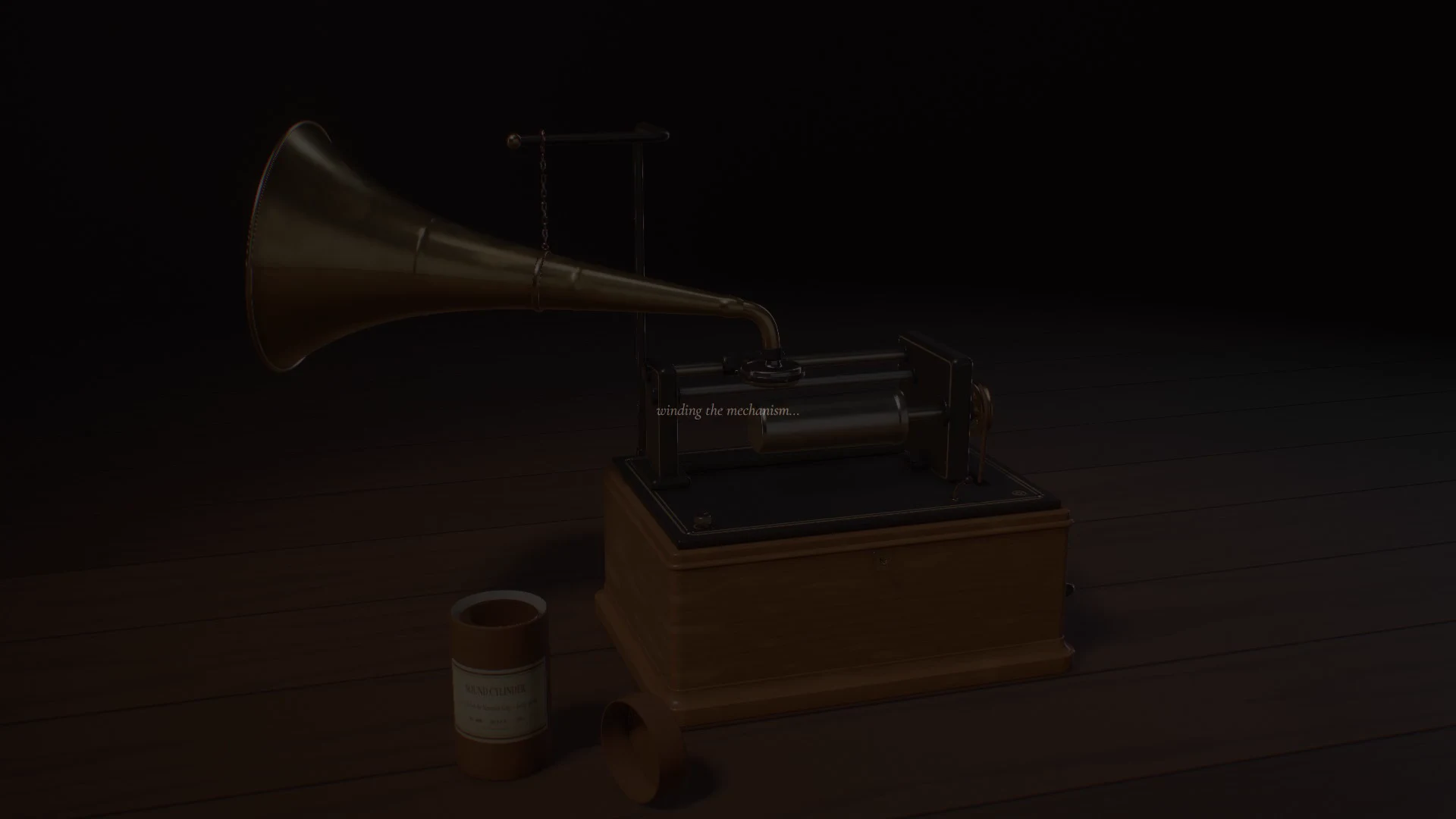
An Edison wax-cylinder phonograph simulated from the groove up in the browser, for anyone curious how sound lived before electricity.
The problem
Most "vintage" audio on the web is a filter: take a clean recording, add crackle and a band-pass, done. It sounds old, but nothing about it is true. I wanted to know what a wax cylinder actually does to sound, and the only honest way to find out was to build the machine.
What I built
A physical simulation of an Edison phonograph that happens to play sound. No recording of a real phonograph is used. Sound is cut as a groove of depths into a wax cylinder, and a 70 µm sapphire ball reads it back.
- One loop, 48,000 times a second. Clockwork turns the mandrel, a 100-thread feed screw moves the carriage one groove per turn, recording writes a depth there and playback reads it back.
- Real contact physics. The ball rests on the groove walls, can't enter dips smaller than itself, and leaves the groove when its weight can't pull it down fast enough. A centrifugal governor holds 160 rpm, the spring lasts 1,100 turns, and wow and flutter grow as it runs down.
- Flaws that come from the wax. Hiss is the grain of the wax, dust is bumps in the groove, and a scratch clicks once per turn because the ball crosses it once per turn.
- Cut your own cylinder. Record from the microphone or drop an audio file. Recordings stay in the browser, in IndexedDB.
- What you see is what you hear. Zoom until one groove fills the screen: the GPU draws the same array the ball reads. The machine is modelled in code from lathes and sweeps, lit with GGX, clear-coat wax, shadows, ambient occlusion, bloom and AgX.
- Sound in space. The horn is the source and the camera is your head (HRTF), so off-axis the sound gets quieter and duller.
- In-app docs and a guided tour, with figures drawn from the same functions the simulation runs.
Under the hood: plain ES modules, WebGL2 and Web Audio, with no dependencies and no bundler. The recorder and reproducer are chains of biquad filters (horn, a diaphragm ringing at 2.3 kHz, wooden box, small room), and the physics has offline tests in Node.
Result
It's live at cylinder-phonograph.vercel.app and open source under MIT. The built-in cylinder plays Grieg's In the Hall of the Mountain King, read from a public-domain score, played by a wavetable piano and then cut and worn like any other recording.
More work

A gallery for the UI components you find on the web, with live previews, made to hand them straight to your AI agent.


A digital menu for restaurants that turns orders into ready-to-send WhatsApp messages, with no commission.


Websites, bookings and an AI menu for independent restaurants, for a flat weekly price and no commission.


The website of a V Rising community server: build creator, command generator, raids and regional leaderboards.